





What this article helps you consider
- Define the quality targets first
- Compare process mechanisms across equipment
- Include material variability
Define the quality targets first
Describe the intended dosage form, strength, release behaviour, uniformity, stability and other relevant attributes. Use the development evidence to identify material properties and process variables that could affect them. ICH Q8 provides a pharmaceutical development framework for connecting product understanding to a control strategy. R32
A critical quality attribute is a property that needs appropriate control to ensure product quality. A process parameter should not be labelled critical merely because it is convenient to record. Establish its relationship to a relevant quality attribute through prior knowledge and experimental evidence, then manage the uncertainty explicitly.
Compare process mechanisms across equipment
A tenfold increase in batch mass does not imply that time, speed or energy input should increase tenfold. Mixing, heat transfer, liquid distribution and drying behaviour can change with equipment geometry and operating regime. Compare the physical mechanism the process must deliver rather than copy a laboratory setting.
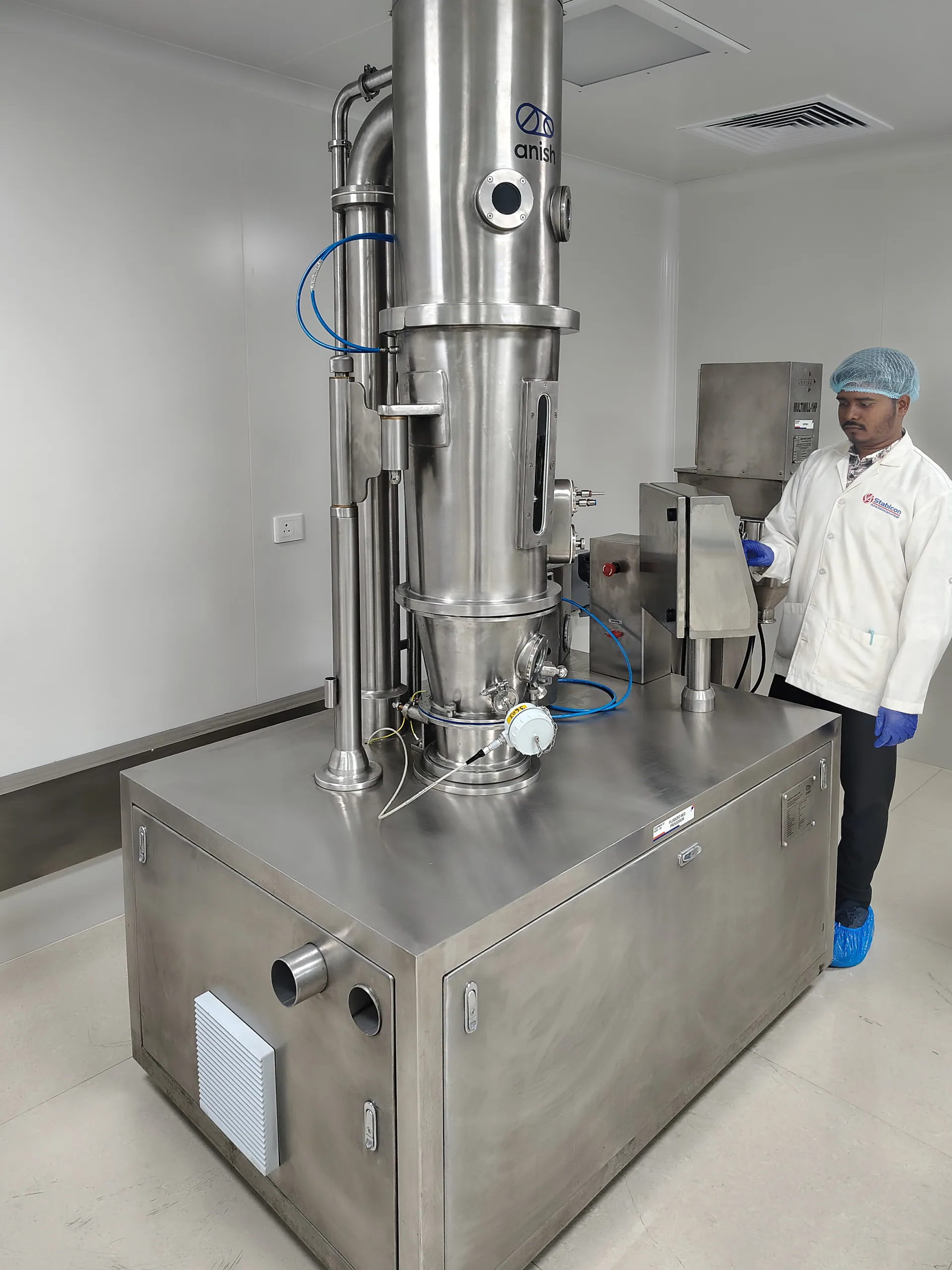
For granulation, examine liquid addition, wetting, shear and endpoint behaviour. For drying, assess air conditions, load, bed behaviour and material temperature. For compression, consider dwell time, feed behaviour, force and lubrication. For coating, examine spray, atomisation, mixing and drying together. Each operation has its own scaling questions.
Include material variability
Particle size, density, moisture and functional excipient properties can affect flow, mixing and compactability. A process developed using one unusually favourable raw-material lot may fail when routine variation appears. Select representative material and investigate the properties most likely to affect performance.
In a hypothetical low-dose tablet, a change in active-particle properties may increase segregation during transfer to the press. A small laboratory blend could appear uniform while commercial handling creates a distribution problem. Compare samples across relevant locations and stages using a justified sampling plan and suitable analytical capability.
Plan the transfer as a project
The sending and receiving teams should agree responsibilities, equipment gaps, documentation, training, analytical readiness and acceptance criteria. WHO’s technology-transfer guidance describes a structured approach that includes due diligence, planning, execution and close-out. The scientific objective is to make the receiving unit capable of controlling the process and its associated tests. R16
The transfer package should explain why controls were selected, not only list settings. Include formulation and material specifications, process descriptions, development findings, known failure modes, analytical methods and stability information as appropriate. Resolve important differences before demonstration batches rather than treating them as surprises during execution.
Distinguish development from validation
Engineering or demonstration batches can test assumptions and reveal gaps. Process qualification and continued verification have different purposes within a validation lifecycle. FDA’s process-validation guidance describes process design, qualification and continued verification as connected stages. It does not establish a universal rule that a fixed batch count proves every process is validated. R33
The qualification strategy should reflect process understanding, variability and risk under the applicable requirements. A successful batch confirms performance under the conditions tested; it does not establish capability across every proposed material and operating range. The illustration shows the evidence needed at successive stages and the feedback from routine monitoring.
Scale changes the process questions
Connect material and process variables with the intended quality attributes.
Conceptual illustration. Select a topic to explore its role. The visual does not establish formulation performance or prescribe universal regulatory requirements.
Learn from routine performance
After transfer, review trends in process parameters, in-process results, finished-product attributes and deviations. Investigate persistent shifts even when individual batches remain within specification. Changes in suppliers, equipment or batch size should be assessed against the established product and process knowledge.
Stabicon can support formulation development, process understanding and technology-transfer documentation so that a promising prototype can be evaluated at the intended scale. A strong handover gives the receiving team the rationale and evidence needed to reproduce quality and recognise meaningful change.
References & further reading
Read the source in its stated scope. Requirements, amendments and compendial editions depend on the product and target market. Draft guidance is identified separately.
- R16WHO Guidelines on Technology Transfer in Pharmaceutical Manufacturing
WHO Technical Report Series 1044, Annex 4, 2022.
- R18ICH Q9 R1 Quality Risk Management
Final guideline adopted January 2023. Scientific and risk-based quality decisions.
- R32ICH Q8 R2 Pharmaceutical Development
Final guideline, August 2009. Product and process understanding and control strategy.
- R33FDA Process Validation General Principles and Practices
Final guidance, January 2011. Process design, qualification and continued verification.
- R34FDA SUPAC IR Scale Up and Post Approval Changes
Final guidance, November 1995. Defined scope for immediate-release pharmaceutical products.
From insight to a defined programme
Bring your next technical question.
Share your formulation, testing objective or development challenge. Stabicon can review the context and define a suitable scope of work.
Discuss this topic with Stabicon