


What this article helps you consider
- Distinguish the impurity classes
- Examine excipient and storage contributions
- Translate daily exposure into an analytical target
Distinguish the impurity classes
Small-molecule nitrosamines and nitrosamine drug substance-related impurities, or NDSRIs, require related but distinct analytical strategies. NDSRIs share structural features with the drug substance and may be unique to a particular active ingredient. A panel of familiar small nitrosamines does not establish that all relevant NDSRIs have been addressed. R07
Assess the actual molecular structure and plausible reaction pathways. Review synthesis, recovered solvents, reagents, water, cross-contamination, formulation components and storage conditions. Where an amine and a potential nitrosating source coexist, the question is whether the conditions and concentrations permit formation at a relevant level, rather than whether a theoretical reaction can be drawn.
Examine excipient and storage contributions
Drug-product risk assessment should include excipients and their variability. Nitrite content can differ among materials and suppliers. Moisture, temperature, local pH and contact between reactants may influence formation during storage. Supplier statements are useful inputs, but their scope and supporting measurements must be understood.
A hypothetical formulation may contain an amine-bearing active and an excipient with measurable nitrite. The development question is whether an NDSRI forms in that actual matrix over time. Comparing ingredient lots, storage conditions and formulation alternatives can help identify the factors responsible. A risk conclusion should change when new stability or supplier information changes its assumptions.
Translate daily exposure into an analytical target
Acceptable intake values relate to daily exposure. Convert the applicable value into a concentration using the correct maximum daily dose and a consistent mass basis. In a simplified example, a hypothetical intake of 100 ng/day and a maximum daily product mass of 2 g correspond to 50 ng/g, or 0.05 ppm. This is arithmetic for illustration and is not a limit for any named nitrosamine.
The quantitation capability must account for extraction, sample dilution, recovery and the intended control level. Reporting a low instrument detection limit alone does not establish that a product method can measure reliably at the required concentration. Use current authority-specific nitrosamine information because recommended intakes and scientific approaches can change. R08R09
Prevent artefacts and false reassurance
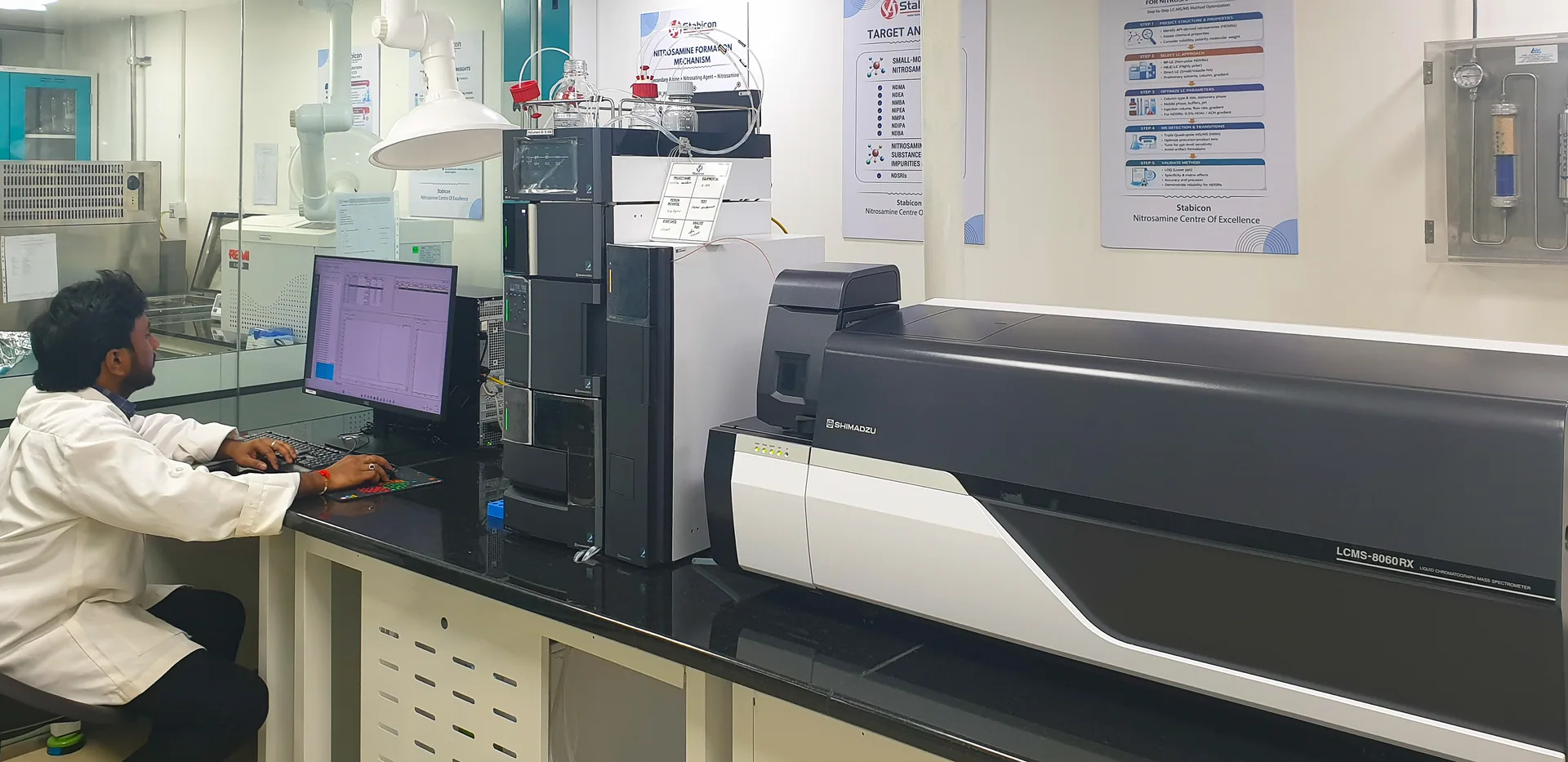
Nitrosamine methods may use liquid or gas chromatography with mass spectrometric detection, depending on volatility, stability and matrix. Assess matrix effects, selectivity, carryover and the suitability of internal standards. Thermal or chemical conditions during preparation and analysis can sometimes create an artefact or alter the target compound.
Use blanks, spiked samples and appropriate controls to distinguish a genuine product signal from contamination or analytical formation. Recovery should be demonstrated at relevant concentrations. An apparent absence is meaningful only when the method’s specificity, recovery and quantitation limit support the conclusion.
Connect detection to mitigation
A confirmed finding should trigger a structured evaluation of identity, exposure, affected batches and potential root causes under the relevant quality and regulatory processes. A control strategy may involve material specifications, supplier changes, process changes, reformulation or packaging adjustments. Any intervention must be evaluated for its effects on the product’s wider quality profile.
For example, a proposed scavenger might reduce nitrosamine formation but affect stability, dissolution or tolerability. It becomes a development candidate requiring evidence rather than an automatic solution. Accelerated experiments can screen options, while representative long-term studies establish their relevance to storage.
Keep the assessment current
The illustration connects pathway assessment, confirmatory testing and control review. Testing frequency should follow the evidence and the applicable authority’s expectations, rather than a universal assumption that every product needs the same panel on every batch. The final record should identify what was assessed, what remains uncertain and what changes require reassessment.
Where formation risks converge
Review the actual chemistry, materials, process and storage conditions.
Conceptual illustration. Select a topic to explore its role. The visual does not establish formulation performance or prescribe universal regulatory requirements.
Stabicon can support risk assessment and targeted analytical development so that nitrosamine testing addresses the relevant product-specific questions. This article concerns human medicines; other product categories require a separate regulatory assessment.
References & further reading
Read the source in its stated scope. Requirements, amendments and compendial editions depend on the product and target market. Draft guidance is identified separately.
- R07FDA Control of Nitrosamine Impurities in Human Drugs
Final guidance, September 2024. Risk assessment, testing and mitigation for medicines.
- R08FDA Recommended Acceptable Intake Limits for NDSRIs
Final guidance, August 2023. Read with current FDA updates.
- R09FDA CDER Nitrosamine Impurity Acceptable Intake Limits
Living information page. Compound-specific values and recommendations can change.
From insight to a defined programme
Bring your next technical question.
Share your formulation, testing objective or development challenge. Stabicon can review the context and define a suitable scope of work.
Discuss this topic with Stabicon