






What this article helps you consider
- Distinguish the two study questions
- Map every relevant contact component
- Design extraction around a defined purpose
Distinguish the two study questions
Extractables are substances released from a material under specified extraction conditions, often chosen to explore potential migrants. Leachables are substances that migrate into the actual product during its manufacture, storage or use. An extractables profile helps identify candidates for assessment; it does not predict every substance that will appear in the product.
Migration can depend on formulation composition, temperature, contact time and material processing. Reaction products may form in the formulation, and substances detectable in an aggressive extraction may not appear under normal use. Keep the relationship between the studies explicit rather than treating one as a complete substitute for the other.
Map every relevant contact component
Review bottles, closures, liners, seals, tubing, filters, pumps and other materials contacting the product. Supplier information should describe the actual grade, additives and processing where relevant. A polymer name alone does not establish the composition of a finished component.
The illustration distinguishes the extraction and product-study questions and connects them to assessment. The scope should include manufacturing contact where it presents a plausible contribution. A packaging-only review may miss substances introduced during filtration or transfer before filling.
Potential migrants and actual product exposure
Defined extraction conditions explore substances that a contact material can release.
Conceptual explanation. No product result, acceptance criterion or universal regulatory sequence is established by this illustration.
Design extraction around a defined purpose
Select solvents, time, temperature and surface-to-volume relationships that answer the study question. Conditions should provide useful information about possible migrants without destroying the material to the point that the result loses relevance. Document the reasoning and distinguish extraction conditions from actual use conditions.
USP chapters 1663 and 1664 provide frameworks for extractables and leachables assessment in pharmaceutical packaging and delivery systems. Consult the applicable current text. ICH Q3E was listed as draft guidance when checked; its proposed framework should not be described as an implemented requirement. R42R43R44
Combine analytical coverage
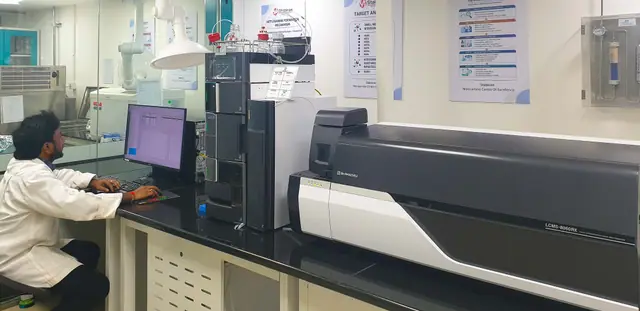
Volatile, semivolatile, nonvolatile and elemental species can require different analytical techniques. Gas chromatography, liquid chromatography, mass spectrometry and elemental analysis provide complementary information. No single screening chromatogram establishes comprehensive coverage of all chemical classes.
Use appropriate blanks to distinguish material-related signals from laboratory background. Assess identification confidence and quantitative uncertainty. A tentative library match is not equivalent to confirmation with an authentic standard. Unknown or partially identified signals require a defined evaluation strategy rather than being omitted because identification is difficult.
Connect thresholds to exposure
An analytical evaluation threshold helps establish which signals need further evaluation under a defined study design. It is not a universal safe concentration for every compound. Daily product use, analytical preparation, concentration factors and method uncertainty influence its practical expression in a test solution.
For a hypothetical multidose liquid, the same leachable concentration can produce different daily exposure at different maximum daily volumes. A toxicological assessment must consider identity, route and relevant hazard information. An analyst should not equate a signal below an arbitrary laboratory reporting threshold with an established absence of risk.
Confirm behaviour in the actual product
Follow relevant candidates and investigate additional signals during product stability and use where appropriate. Include suitable time points and the actual formulation, since pH, solvents and surfactants can influence migration. A material change may require reassessment even when mechanical dimensions and appearance remain unchanged.
Stabicon can support analytical screening and targeted evaluation within an agreed study scope. Product-contact assessment should connect analytical work with qualified toxicological review and the applicable pharmaceutical or food-contact framework; the two regulatory contexts are not interchangeable.
References & further reading
Read the source in its stated scope. Requirements, amendments and compendial editions depend on the product and target market. Draft guidance is identified separately.
- R42FDA ICH Q3E Guideline for Extractables and Leachables
Draft guidance, November 2025, as listed when checked. Not for implementation.
- R43USP General Chapter 1663 Assessment of Extractables
Official publisher preview. Consult the current applicable chapter for complete guidance.
- R44USP General Chapter 1664 Assessment of Drug Product Leachables
Official publisher preview. Consult the current applicable chapter for complete guidance.
- R21FSSAI Health Supplements and Nutraceuticals Standards
Official regulations portal. Verify current amendments, permitted ingredients, levels and category-specific requirements.
From insight to a defined programme
Bring your next technical question.
Share your formulation, testing objective or development challenge. Stabicon can review the context and define a suitable scope of work.
Discuss this topic with Stabicon